This isn't just free food. It's a movement to end waste — block by block.
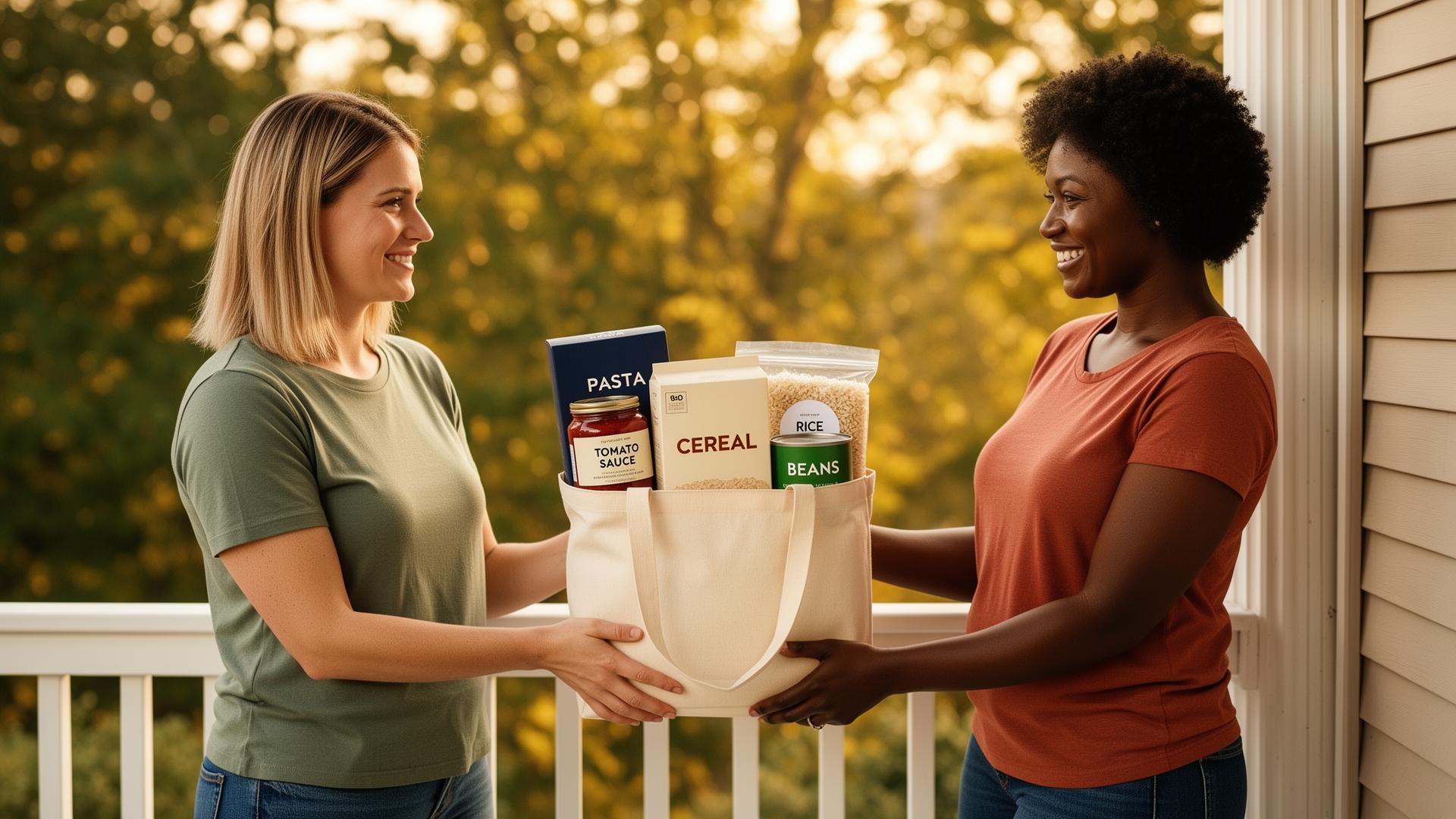
Food Finder is a grass-roots, hyper-local cause. The exchange is the surface; the mission underneath is bigger. Every unopened jar, sealed bag, and untouched carton that moves from one neighbor's kitchen to another's — instead of into a landfill — is a small act of community climate work.
We're not a charity. We're not delivery. We're a platform that lets ordinary people do something extraordinary with the surplus already sitting in their cupboards: pass it five doors down instead of throwing it out.
What "block by block" actually adds up to.
The average American throws out 174 lbs of food a year. If neighbors redirected even 10% of that to someone on their street instead of the trash, the numbers move fast.
20 households trading their unfinished groceries for one year.
≈ 109 full grocery bags kept out of landfill
A 60-unit apartment building running a lobby QR code.
≈ 326 full grocery bags kept out of landfill
500 households sharing what they were going to toss anyway.
≈ 2,719 full grocery bags kept out of landfill
We publish real totals once they mean something. Pre-launch, an empty counter doesn't tell the truth about what this becomes. Once neighbors are posting, you'll see live pounds-saved, items shared, and connections made — right here.
Projection math: 174 lbs/person/yr (USDA & ReFED household waste estimates) × 2.5 people/household × 10% conservative redirect rate. One "grocery bag" ≈ 8 lbs.
A grass-roots fix to a global problem.
Big problems are usually solved one block at a time. Food waste is one of those problems. The solution doesn't live inside a corporation or a government program — it lives inside the everyday choices neighbors make about what's in their fridge.
Food Finder exists to make that choice frictionless. Post in 30 seconds. Pick up in 5 minutes. Multiply that by a block, then a neighborhood, then a city, and the total impact moves from"nice gesture" to"real dent."
Most food waste happens at home.
According to the UN Environment Programme's Food Waste Index Report 2024, the world threw out an estimated 1.16 billion tons of food in 2022 — roughly one-fifth of all food that reached consumers.
60% of that waste — about 696 million tons — happens in households. Food service is another 28%, retail just 12%. The single biggest lever is what individual neighbors do with the extra food in their own kitchens.
Wasted food is one of the planet's biggest climate problems.
Food loss and waste generates an estimated 8–10% of global greenhouse gas emissions — nearly five times the entire aviation sector. If food waste were a country, it would be the third-largest emitter on Earth.
Every wasted apple, loaf, or jar represents the water, land, fuel, fertilizer, packaging, and labor used to produce it — all spent for nothing. Reducing waste is one of the most powerful climate actions an ordinary person can take.
Real, relatable, repeatable.
None of these need a campaign, a non-profit, or a permit. Just neighbors with a phone and 30 seconds to spare.
One street. One Saturday. Twenty pounds saved.
SetupA quiet residential block decided to try Food Finder together for one weekend. Eight households opted in.
What happenedBy Sunday night, 14 listings had been posted and claimed within a four-block radius — half-cases of sparkling water, sealed pasta, unopened produce bags from a Costco run, a pantry cleanout from a family heading on vacation.
OutcomeRoughly 20 pounds of food that would have hit the curb on Tuesday's trash day went into neighbors' kitchens instead. Most pickups happened in under an hour.
"We didn't organize a thing. Everyone just posted what they had and walked over to get it."
A 60-unit building turned move-out week into share week.
SetupEnd of August. Leases ending. Dozens of residents about to throw out perfectly good pantries because they couldn't take them on the moving truck.
What happenedBuilding management put a single Food Finder QR code in the lobby. Movers became Sharers. Incoming residents and neighbors became Finders.
OutcomeInstead of dumpsters full of unopened jars, oils, canned goods, and dry pasta, the building's waste hauler reported the lightest move-out week in three years.
"I felt sick every August watching what we threw out. This year that pile didn't exist."
A small town redirected a vacation week of groceries.
SetupSchool's out. Half the town leaves for a week. Fridges full of milk, eggs, bread, and produce all sitting in kitchens that won't be opened for seven days.
What happenedNeighbors started posting their pre-vacation fridge contents on Food Finder before they hit the road. Locals staying in town picked up everything within hours.
OutcomeWhat used to be a predictable post-vacation trash pile became a quiet community handoff. No food bank logistics, no charity, no middlemen — just neighbors trading what they already had.
"It's the most useful thing I've ever done five minutes before getting in the car."
The math gets interesting fast.
If the average person tosses about 174 lbs of food per year, redirecting even a fraction of that to a neighbor — instead of the bin — adds up quickly across a block, then a neighborhood, then a city.
- Sharers: the canned goods you'll never get to, the produce you over-bought, the unopened snacks the kids stopped liking — list them in 30 seconds.
- Finders: grab quality food close to home, skip a grocery run, and keep something good out of the landfill in the same trip.
- All-access: get to know the people on your block. Food has always been how communities form.
Less waste. Smarter neighborhoods. Same block.
Whether you've got extra to share or could use what someone else won't, you belong here.
Sources
- UNEP, Food Waste Index Report 2024.
- UN Sustainable Development Goal 12.3 — Halve global food waste by 2030.
Case studies are illustrative composites of real Sharer and Finder behavior on comparable community-sharing efforts.